Data Matrix vs QR code : lequel choisir pour votre entreprise ?
Ils se ressemblent sur un bon de livraison — jusqu’à ce que le mauvais format échoue au scan téléphone ou à l’audit. Voici comment choisir entre Data Matrix et QR pour de vrais flux.
Ce guide est rédigé en anglais. Le titre et le résumé ci-dessus sont localisés.
A marketing team prints Data Matrix symbols on a poster. Shoppers point their phones at it and nothing happens. A factory swaps part labels to QR codes and the line scanners stop reading. A healthcare supplier picks the wrong 2D format and walks into a compliance headache.
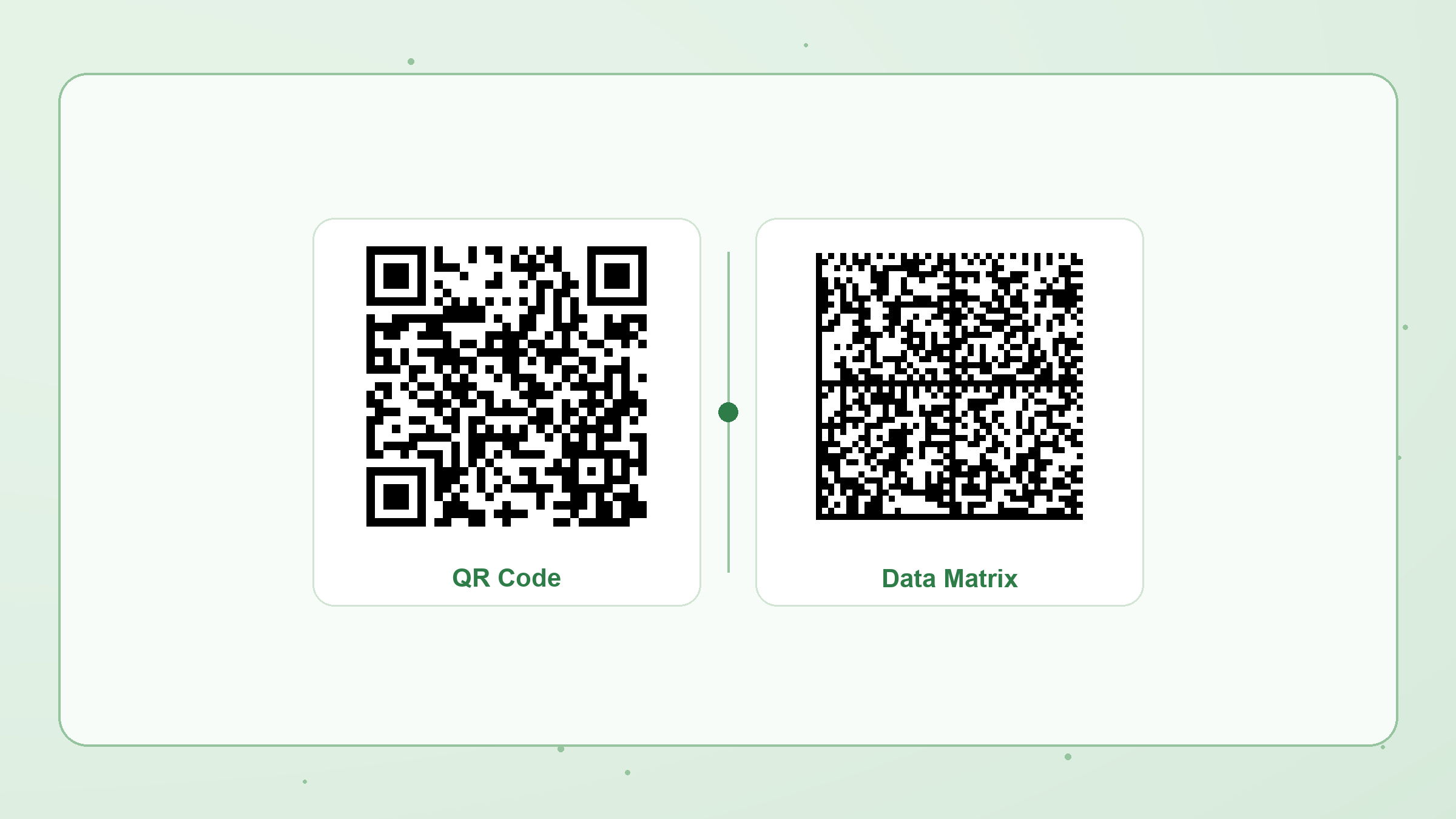
QR codes and Data Matrix codes both store data in a grid of modules. They are not interchangeable. They were designed for different scanners, different environments, and different people. This guide compares them side by side and gives you a simple decision framework.
Why the choice matters
At a glance the symbols look related. In practice your choice affects:
- Compliance — some industries and trading partners specify Data Matrix (for example under ISO/IEC 16022 workflows).
- Who can scan — consumers expect phone cameras; factory cells expect fixed industrial readers.
- Size and durability — tiny parts and harsh surfaces favor dense industrial marks; print marketing favors familiar QR eyes.
- Downstream systems — ERP, MES, and warehouse vision stacks are often configured for one symbology.
What is a Data Matrix code?
A Data Matrix code is a square or rectangular matrix with a characteristic L-shaped finder on two sides. That border helps industrial scanners lock orientation even when the mark is small or partially worn.
Data Matrix packs a lot of data into a small footprint—useful when the “label” is laser-etched onto metal or plastic (direct part marking). Typical capacity is on the order of a couple of thousand alphanumeric characters, with Reed–Solomon error correction so scuffs do not always kill readability.
Common homes for Data Matrix: medical devices and instruments, aerospace and defense parts, automotive components, electronics boards, and regulated pharma packaging where machine vision—not a customer phone—is the primary reader.
What is a QR code?
A QR code is a square matrix with three prominent position detection patterns in the corners. Those “eyes” make it easy for smartphone cameras to find the code quickly from many angles.
QR codes were optimized for people and digital handoffs: open a URL, join Wi‑Fi, save a vCard, launch a payment URI. Capacity is generous for those jobs (thousands of characters depending on mode and version). On Make a QR, the payload is encoded into the pattern itself when you download PNG or SVG—so the file you print keeps working without an account hanging off the side.
Common homes for QR: packaging and shelf talkers, menus and event signs, business cards, Wi‑Fi stickers, document footers, and any place a stranger with a phone should succeed on the first try.
Side-by-side comparison
| Factor | Data Matrix | QR code |
|---|---|---|
| Primary job | Traceability & industrial ID | Human + phone experiences |
| Who scans | Machine vision / industrial scanners | Smartphones & general 2D imagers |
| Tiny marks | Excellent density | Needs more space for similar data |
| Harsh surfaces | Built for DPM & wear | Everyday print & screens |
| Regulated mandates | Often specified | Rarely mandated as Data Matrix is |
| Consumer UX | Unreliable on stock phone cameras | Native on modern iOS / Android |
Which should you use?
Choose Data Matrix when you need
- Part-level traceability across a long lifecycle
- Direct part marking on very small components
- Alignment with a customer or regulator that names Data Matrix
- Scanners that are already validated for ISO/IEC 16022 marks
Choose QR when you need
- Guests, customers, or staff scanning with a phone
- Links to pages, forms, maps, menus, or docs you already host
- Fast creative iteration (colors, logo, module shapes) for print
- Tools that non-engineers can run without a vision cell
When both make sense
Many manufacturers put Data Matrix on the component for internal traceability and a QR on the outer carton for the human story—manuals, support, registration. Different audiences, different symbols, same shipment.
Practical tips if you pick QR
- Keep dark modules on a light quiet zone; test iPhone and Android before a big print run.
- For Wi‑Fi, vCard, and URL jobs, generate on Make a QR and download PNG for stickers or SVG for large format.
- If you only need to read a sample mark from a photo, use Decode on the desktop.
Make a QR focuses on QR for phone-friendly static payloads. We do not try to replace industrial Data Matrix marking pipelines—and you should not ask a consumer campaign to depend on Data Matrix either.
FAQ
What is the main difference?
QR is built for people with phones. Data Matrix is built for industrial identification and dense marks that machines read for years.
Can phones scan Data Matrix?
Not reliably with built-in cameras. Dedicated apps exist, but if consumers are the audience, use QR.
Is Data Matrix better for tiny labels?
Usually yes for extreme miniaturization. For ordinary stickers and posters, QR size is rarely the limiting factor.
Can I use both?
Yes—pair them when one audience is a vision system and the other is a person with a smartphone.